Introduction: Lead Volume Is No Longer Enough
Many companies still judge lead generation by the easiest number to count: how many leads came in this month. That number is useful, but it is not enough. A campaign can produce hundreds of form fills and still fail if those leads never become sales opportunities. Another campaign can produce fewer leads but generate a stronger pipeline because the prospects have budget, authority, urgency and a real fit with the business.
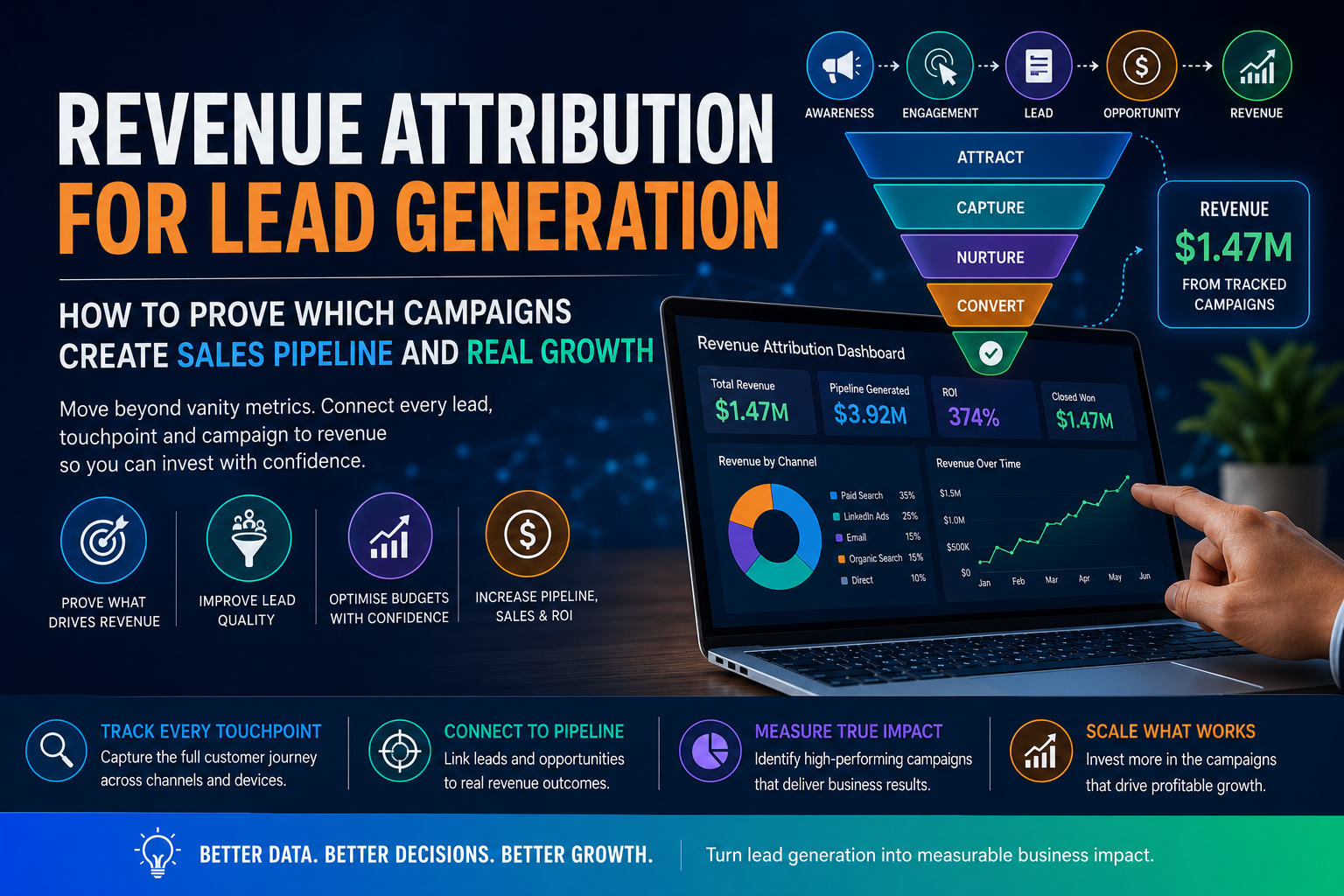
This is where revenue attribution becomes critical. It helps marketers, sales leaders and business owners connect marketing activity to sales outcomes. Instead of asking only how many leads were generated, a proper attribution system asks better questions: which channel created the first meaningful contact, which content influenced the buyer, which landing page converted the account, which sales follow-up moved the deal forward and which campaign contributed to closed revenue?
For a performance-led lead generation business, attribution is not a reporting luxury. It is the operating system that decides where budget should go next. Without attribution, teams rely on assumptions, platform dashboards and whoever argues most convincingly in the meeting. With attribution, they can compare sources, funnel stages and opportunity quality using evidence.
What Is Revenue Attribution?
Revenue attribution is the process of assigning credit to the marketing and sales touchpoints that contribute to a lead, opportunity or closed deal. In simple terms, it helps answer the question: what actually created this revenue?
A touchpoint can be almost any measurable interaction. It may be a Google search click, LinkedIn ad, webinar registration, email open, gated guide download, organic blog visit, referral visit, sales call, remarketing campaign, demo booking or CRM nurture sequence. In B2B lead generation, a buyer may touch several of these before speaking to sales or signing a contract.
The purpose of attribution is not to create a perfect historical record of every tiny interaction. That is usually impossible. The purpose is to create a reliable enough view of what influences real pipeline so teams can make better decisions.
Lead attribution vs revenue attribution
Lead attribution and revenue attribution are related, but they are not the same.
| Type | What it measures | Why it matters |
| Lead attribution | Identifies which source or campaign generated the lead | Useful for measuring form fills, calls, chats and enquiries |
| Revenue attribution | Connects campaign influence to pipeline value and closed revenue | Useful for budget allocation, sales alignment and growth planning |
| Why the distinction matters | A source can generate many leads but little revenue | Revenue attribution protects budget from vanity metrics |
A lead source that looks successful in Google Analytics may look weak inside the CRM if its leads rarely become qualified opportunities. On the other hand, a channel with modest lead volume may deserve more budget if it produces high-value accounts. Revenue attribution helps expose that difference.
Why Attribution Matters More in 2026
First, B2B buyers are doing more independent research. Gartner reported in 2025 that 61% of surveyed B2B buyers preferred a rep-free buying experience, while 73% actively avoided suppliers that sent irrelevant outreach. That means marketing must work harder before a sales conversation ever happens. Content, search visibility, advertising, reviews and AI search all influence the buyer before the first call.
Second, buyers are using AI and digital self-service, but still need human validation. Gartner reported in 2026 that 69% of B2B buyers prefer to validate AI-generated insights with sales representatives. This creates a hybrid journey: AI and digital content shape the early decision, while sales teams help confirm fit, risk and implementation detail.
Third, marketing teams have more tools but not always better clarity. Salesforce marketing statistics show that 88% of marketers use analytics or measurement tools, 86% use CRM systems and 84% use first-party data, yet only 31% are fully satisfied with their ability to unify customer data sources. That gap matters because attribution depends on data being connected across platforms.
Fourth, privacy and signal loss have made simplistic tracking less reliable. Browser controls, cookie restrictions, consent settings, platform walled gardens and offline sales activity all make the customer journey harder to stitch together. A 2026 research paper on integrated marketing attribution described the problem clearly: marketing mix modelling is privacy-safe but often too broad for campaign optimisation, while multi-touch attribution is granular but less reliable under privacy restrictions.
The Attribution Problem in Lead Generation
Lead generation usually involves multiple channels. A prospect may first see a LinkedIn ad, later search for the company on Google, read a comparison article, attend a webinar, click a remarketing ad, speak to sales and then convert after a follow-up email. If the CRM credits only the last form fill, the earlier influences disappear.
- SEO gets underfunded because its early research role is not visible in last-click reporting.
- Paid search gets over-credited because it often captures demand created elsewhere.
- Brand campaigns look weak because they do not always create immediate conversions.
- Sales follow-up gets blamed for poor conversion when lead quality was the real issue.
- Agencies optimise for cost per lead instead of cost per qualified opportunity.
Start With the Right Definitions
Attribution fails when teams do not define what they are measuring. Before building dashboards, agree on the lifecycle stages that matter.
| Stage | Practical definition | Typical data required |
| Visitor | Someone who visits the website or landing page | Sessions, source, medium, page path |
| Lead | Someone who submits a form, calls, chats or otherwise identifies themselves | Lead source, campaign, form, offer |
| MQL | A lead that fits basic marketing qualification rules | Fit, engagement, intent, consent |
| SQL | A lead accepted by sales as worth pursuing | Sales acceptance, contactability, need |
| Opportunity | A qualified sales deal with potential value | Pipeline amount, stage, expected close date |
| Customer | A closed-won deal | Revenue, source, campaign influence |
| Revenue-qualified opportunity | An opportunity that matches ideal customer profile and has real revenue potential | Fit, budget, authority, urgency, value |
These definitions should be documented in the CRM. Marketing and sales must use the same language. If marketing calls something an MQL but sales sees it as unqualified, the attribution report will not be trusted.
Choose the Right Attribution Model
| Model | How it works | Best used for | Main limitation |
| First-touch | Gives all credit to the first known interaction | Understanding demand creation | Ignores later conversion influence |
| Last-touch | Gives all credit to the final interaction before conversion | Simple lead source reporting | Over-credits bottom-funnel channels |
| Linear | Shares credit equally across tracked touchpoints | Basic multi-touch visibility | Treats all touches as equally important |
| Time-decay | Gives more credit to recent interactions | Shorter sales cycles | May undervalue early education |
| U-shaped | Emphasises first touch and lead creation touch | Lead generation programmes | Less useful for long B2B deals |
| W-shaped | Credits first touch, lead creation and opportunity creation | B2B pipeline reporting | Requires clean CRM stage tracking |
| Data-driven | Uses statistical modelling to assign fractional credit | Larger datasets and platform-level optimisation | Can be opaque and platform-specific |
| Marketing mix modelling | Uses aggregated data to estimate channel contribution | Privacy-safe budget planning | Less granular for individual campaigns |
Google Analytics explains that data-driven attribution assigns credit based on how each ad interaction changes the estimated probability of a key event. This makes it more sophisticated than fixed rule-based models, but marketers still need to interpret it within the limits of their data and platform coverage.
Build the Attribution Foundation
1. Standardise UTM tracking
UTM parameters are simple, but they are often messy. Inconsistent naming can destroy attribution quality. One team uses linkedin, another uses LinkedIn, another uses paid-social and another uses cpc. The result is fragmented reporting.
Create a naming convention for source, medium, campaign, content and term. Document it. Enforce it across paid media, email, social, partner campaigns and QR codes. Use lowercase naming where possible and avoid manual improvisation.
2. Connect website analytics to CRM
Website analytics can show what happened before a form submission. The CRM can show what happened after. Attribution needs both. If Google Analytics, ad platforms and the CRM are disconnected, marketers can see leads but not revenue quality.
At minimum, pass source, medium, campaign, landing page and form name into hidden CRM fields. For phone calls, use call tracking where appropriate. For sales meetings, make sure the booking source is preserved. For offline deals, upload conversion data back into advertising platforms where allowed and compliant.
3. Track lifecycle stages consistently
A lead should not sit forever as a generic contact. It should move through defined stages: new lead, contacted, MQL, SQL, opportunity, closed won, closed lost or disqualified. Each stage should have timestamps. These timestamps help calculate speed to lead, lead-to-MQL rate, MQL-to-SQL rate, SQL-to-opportunity rate and opportunity-to-close rate.
4. Capture rejection reasons
Lost and disqualified leads are valuable data. A lead may be rejected because the budget is too low, the location is wrong, the need is not relevant, the company is too small, the contact is unresponsive or the timing is not right. Without these reasons, marketing only sees that the lead failed. With reasons, marketing can improve targeting, messaging and qualification.
5. Align sales and marketing reporting
Attribution should not be owned only by marketing. Sales must be part of the process because sales teams know which leads are serious and which ones waste time. A good attribution dashboard should be reviewed by both teams every month, not only when budgets are being cut.
The Metrics That Actually Matter
Cost per lead is not useless, but it is incomplete. A lead generation programme should be judged by a ladder of metrics that connect activity to revenue.
| Metric | What it reveals | Why it matters |
| Cost per lead | How efficiently campaigns generate enquiries | Good for early optimisation, weak for revenue quality |
| Lead-to-MQL rate | Whether leads meet qualification rules | Shows targeting and offer quality |
| MQL-to-SQL rate | Whether sales accepts the leads | Shows sales alignment |
| SQL-to-opportunity rate | Whether conversations become real deals | Shows commercial fit |
| Opportunity value | How much pipeline is created | Shows revenue potential |
| Close rate | How many opportunities become customers | Shows deal quality and sales effectiveness |
| Cost per opportunity | Spend divided by qualified opportunities | Better than cost per lead for B2B |
| Revenue attributed | Closed revenue influenced by campaigns | The strongest business metric |
| Payback period | How long it takes to recover acquisition cost | Useful for cash-flow planning |
How AI Can Improve Attribution
AI can help attribution, but it should not be treated as a magic answer. Its value depends on the quality of the underlying data.
AI can identify patterns that are hard to see manually. It can group leads by behaviour, predict conversion probability, score accounts, detect campaign fatigue, summarise sales notes, flag missing data and recommend budget shifts. It can also help sales teams understand which content a prospect engaged with before a call.
However, AI can also amplify bad data. If the CRM is full of duplicate contacts, missing sources, incorrect lead stages and inconsistent campaign names, an AI model may produce confident but misleading recommendations.
Compliance Considerations for Singapore Businesses
Attribution often involves personal data, especially when a company tracks form submissions, phone enquiries, email engagement, CRM activity and sales conversations. Singapore businesses must treat this seriously.
The Personal Data Protection Act governs how organisations collect, use and disclose personal data in Singapore. The PDPC also explains that the Do Not Call provisions form part of the PDPA and apply to certain marketing messages sent to Singapore telephone numbers. Organisations should understand when consent is needed, how withdrawal of consent should be handled and when DNC checks may be required.
For practical lead generation, this means teams should:
- Collect only data that is necessary for a legitimate business purpose.
- Use clear privacy notices on forms and landing pages.
- Avoid uploading personal data into unapproved AI tools.
- Respect consent withdrawal and unsubscribe requests.
- Check DNC requirements before sending applicable telemarketing messages.
- Limit CRM access to people who need it for their roles.
- Keep vendor contracts and data processing arrangements clear.
- Review retention periods so old lead data is not kept indefinitely.
A Practical Attribution Dashboard
A useful dashboard should be simple enough for management to understand and detailed enough for marketers to act on. It should not be a decorative wall of charts.
At minimum, include the following views:
- Channel performance: leads, MQLs, SQLs, opportunities, revenue and cost by channel.
- Campaign performance: spend, qualified opportunities and revenue by campaign.
- Landing page performance: conversion rate, qualification rate and opportunity value by page.
- Lead quality: rejection reasons, sales acceptance rate and average lead score.
- Sales velocity: time from lead to first contact, opportunity creation and close.
30-Day Implementation Plan
Businesses do not need to build a perfect attribution system on day one. Start with a focused 30-day plan.
| Timeline | Action | Outcome |
| Week 1 | Audit current tracking | Identify missing UTM fields, CRM gaps, duplicate contacts and unclear lifecycle stages |
| Week 2 | Define lead stages and attribution rules | Agree on MQL, SQL, opportunity and revenue-qualified opportunity definitions |
| Week 3 | Connect data sources | Pass campaign fields into CRM, link forms, calls and booking tools to lead records |
| Week 4 | Launch dashboard and review cadence | Create a management view and hold the first sales-marketing attribution review |
Common Mistakes to Avoid
- Treating all leads as equal instead of separating low-intent contacts from revenue-qualified opportunities.
- Using last-click data as the only source of truth.
- Ignoring offline sales activity, phone calls and manual follow-ups.
- Letting every campaign manager invent their own UTM naming rules.
- Reporting platform conversions without checking CRM revenue quality.
- Collecting personal data without clear consent, purpose or retention rules.
- Optimising for cost per lead while ignoring cost per opportunity and close rate.
Conclusion: The Future of Lead Generation Is Revenue-Proven
Lead generation is becoming more competitive, more data-driven and more accountable. Buyers are researching independently, using AI, comparing more options and expecting relevant outreach. At the same time, privacy rules and tracking limitations make simplistic reporting less reliable.
In this environment, businesses cannot afford to optimise only for lead volume. They need to know which campaigns create qualified opportunities, which channels influence revenue and which activities deserve more investment.
Revenue attribution provides that discipline. It does not promise perfect certainty. It provides decision-grade evidence. It helps teams stop debating opinions and start improving the funnel based on business outcomes.
The companies that win in 2026 will not be the ones with the biggest dashboards. They will be the ones that can connect marketing spend to pipeline, pipeline to revenue and revenue back to smarter campaign decisions.
FAQs
1. What is revenue attribution in lead generation?
Revenue attribution is the process of connecting marketing and sales touchpoints to pipeline and closed revenue. It helps businesses understand which campaigns, channels and content assets influence qualified opportunities and actual sales, not just raw lead volume.
2. Why is cost per lead not enough?
Cost per lead only shows how cheaply a campaign generates enquiries. It does not show whether those leads are qualified, accepted by sales or likely to become customers. A low cost per lead can still be wasteful if the leads do not convert into pipeline or revenue.
3. Which attribution model is best for B2B lead generation?
There is no single best model for every business. Many B2B teams use a combination of first-touch, last-touch and opportunity-stage attribution. For longer sales cycles, W-shaped or CRM-based revenue attribution may provide a more useful view than simple last-click reporting.
4. How can small businesses start with attribution?
Start by standardising UTM tracking, passing lead source data into the CRM, defining lead stages and reviewing which sources create qualified opportunities. Small businesses do not need advanced modelling at first. Clean, consistent tracking is usually the highest-impact first step.
5. Does attribution need to comply with Singapore privacy laws?
Yes. Attribution may involve personal data such as contact details, form submissions, call records and CRM activity. Singapore businesses should follow PDPA obligations, use clear privacy notices, manage consent properly, respect withdrawal requests and check DNC requirements when sending applicable marketing messages to Singapore telephone numbers.
Source Notes
- MediaOne.sg homepage and lead generation positioning
- MediaOne.sg Insights topics
- Gartner: 61% of B2B buyers prefer a rep-free buying experience
- Gartner: 69% of B2B buyers prefer to validate AI-generated insights with sales reps
- Salesforce marketing statistics
- Google Analytics Help: data-driven attribution
- PDPC: Singapore Do Not Call provisions for organisations
- Integrated Marketing Attribution research, arXiv 2026